The Anatomy of a Beat
A detailed analysis of what happens inside a single, discrete moment, and how we understand it from outside.
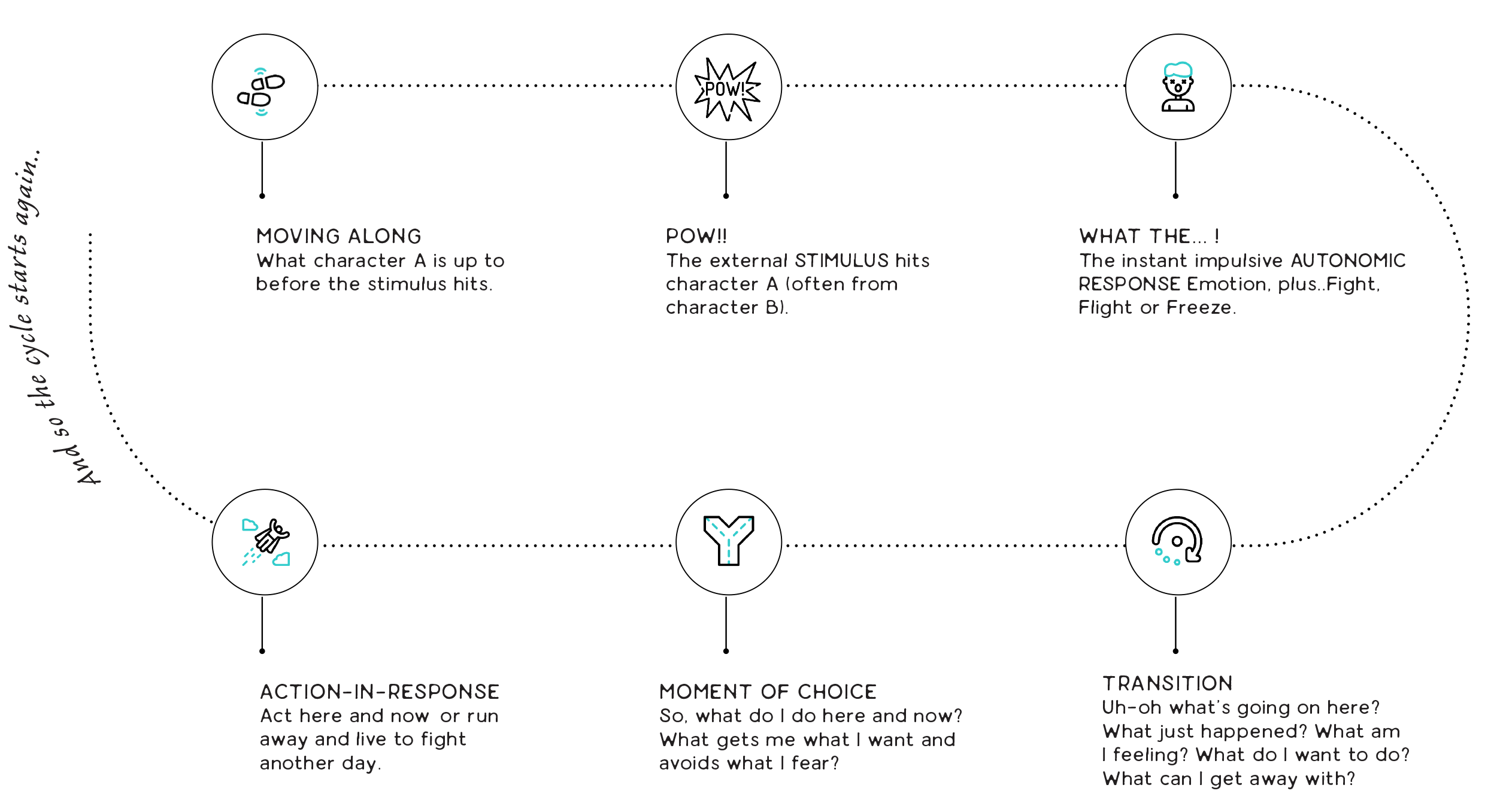
Having originally trained as an actor, I use the term ‘beat’ in Stanislavski’s original sense, rather than the contemporary ‘story beats’. We can break down any single ‘ story beat’ into a chain of character micro-beats, with the following elements:

MOVING ALONG
What character A is up to before the external stimulus hits.
Interesting characters are rarely static. They’re always moving along psychologically, measuring the world around them, and pursuing their needs. They are psychologically active.
This doesn’t always mean they are physically active – physical movement is not action. A character may choose to be perfectly still, but at the same time strongly pursue their objective.
Still or moving, a character needs to be alive at every moment – measuring, assessing, predicting, and doing. All in pursuit of what they hope for, or hanging on to what they have, or avoiding what they fear. A character may be perfectly still and at the same time be the most alive person on screen – especially if they’re working against a compelling impulse to move or speak.
Conversely, a character can charge all over the place and simply be dissipating what little psychological energy they have.
To describe this micro-beat in the language of acting, the character enters the moment with emotional weight, something at stake, a need, and a tangible objective. The interaction of all these forces creates a specific, carefully crafted action. And, like all actions, this action comes with a specific tangible need with a measurable outcome that they are actively pursuing.
In short, even before the moment, the character is alive, in the moment, psychologically in motion, and with immediate hopes and fears – even if they are trying to keep those fears and hopes, and their strategies for pursuing them, hidden.
Then something happens that throws this all up in the air.

POW!!
The external STIMULUS hits character A (often from character B).
Something tangible happens to the character in the scene (the ‘stimulus’) that knocks them sideways. They get a new piece of information that changes something significant and immediate – and which immediately demands they work out what to do about it.
Most often, this stimulus comes from another character, but not always. Calling this stimulus a ‘new piece of information’ makes it seem very intellectual – but information comes in many forms. It certainly doesn’t need to be verbal. All the following (and much more) fit the bill:
- I thought he was my ally.
- She’s still angry with me.
- He hasn’t actually got the money.
- He’s flirting with me.
- He’s got no idea how I feel.
- She hasn’t realised that I already know.
- She’s trying to hide something from me.
- The train isn’t running today.
- That car is going to go through the red light.
- That dog is vicious and has me in its sights.
From the audience’s point of view, the main thing is that the stimulus must be tangible and visible or audible to them. You can hide every other part of this process except the stimulus and the action-in-response, and as long as the audience knows those two things, they will infer the rest.
We can’t help but make up a story that connects those two moments. Humans have a powerful instinct to create little narrative moments out of those two bits of information – it’s the ‘Theory of Mind’ impulse.
If there’s enough at stake for the character, the impact of the stimulus creates an ‘Ekman moment’ – the AUTONOMIC RESPONSE. [I use Ekman moment to describe a universally recognised micro-expression that transcends language or culture.]
Labelling: System 1/System 2
The following diagrams refer to the System 1/System 2 dichotomy, also known as the Impulsive/Deliberative distinction.
System 1 (Unconscious, Impulsive):
Fast, intuitive, automatic, emotional. Operates without conscious effort. Responsible for gut reactions and heuristics.
System 2 (Considered, Rational):
Slow, deliberate, effortful, and logical. Requires conscious attentionand effort. Used for complex problem-solving and decision-making.
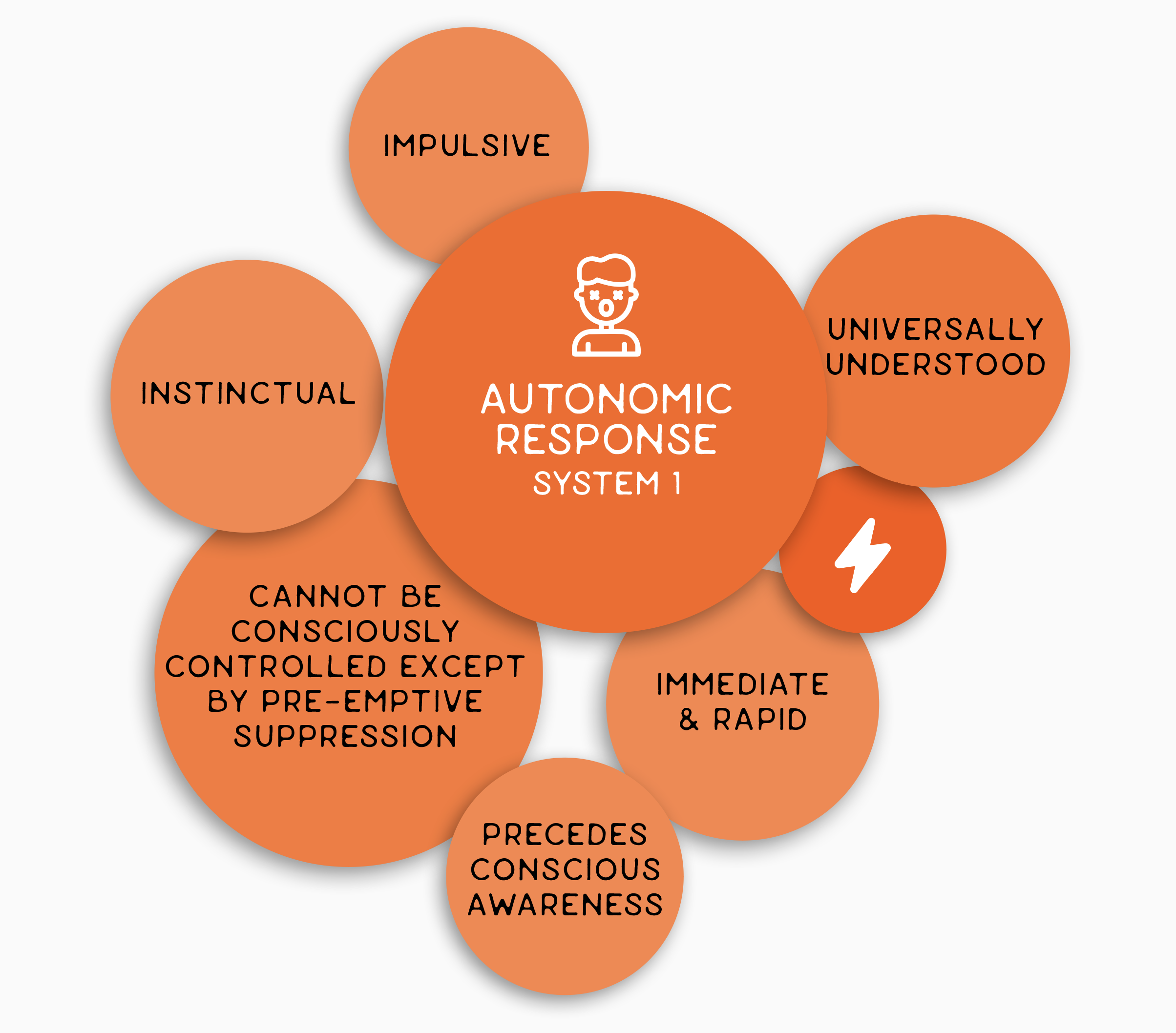
In technical terms, the impulsive micro‑reaction is subcortical (e.g., amygdala/salience systems) and precedes conscious control. More importantly, because it precedes conscious thought, it comes from the actor, not the character, and, in my opinion, cannot be successfully faked in close-up on screen.
[It can be faked on stage, where the audience is much further away. Plus, theatre goers are generally more receptive to indicative acting, which they see as part of the performative art. Some very successful stage actors never made the transition to screen, because they haven’t developed the processes for building authentic impulsive responses into performance.]
Because of this, in my opinion, it’s better to withhold the impulsive response than fake it or force it.
The Actor/Character nexus
Luckily, the audience doesn’t distinguish between the actor’s autonomic responses and the character’s autonomic responses. They happily ascribe the actor’s response to the character if they are allowed to. This has all sorts of implications for the actor and director. The only thing that matters for a writer is understanding that psychological subtext arises from the struggle between the impulsive and the deliberate responses, and that this often leads to non-sequiturs.
The AUTONOMIC RESPONSE leads directly into the TRANSITION as the conscious mind tries to get control of the situation.
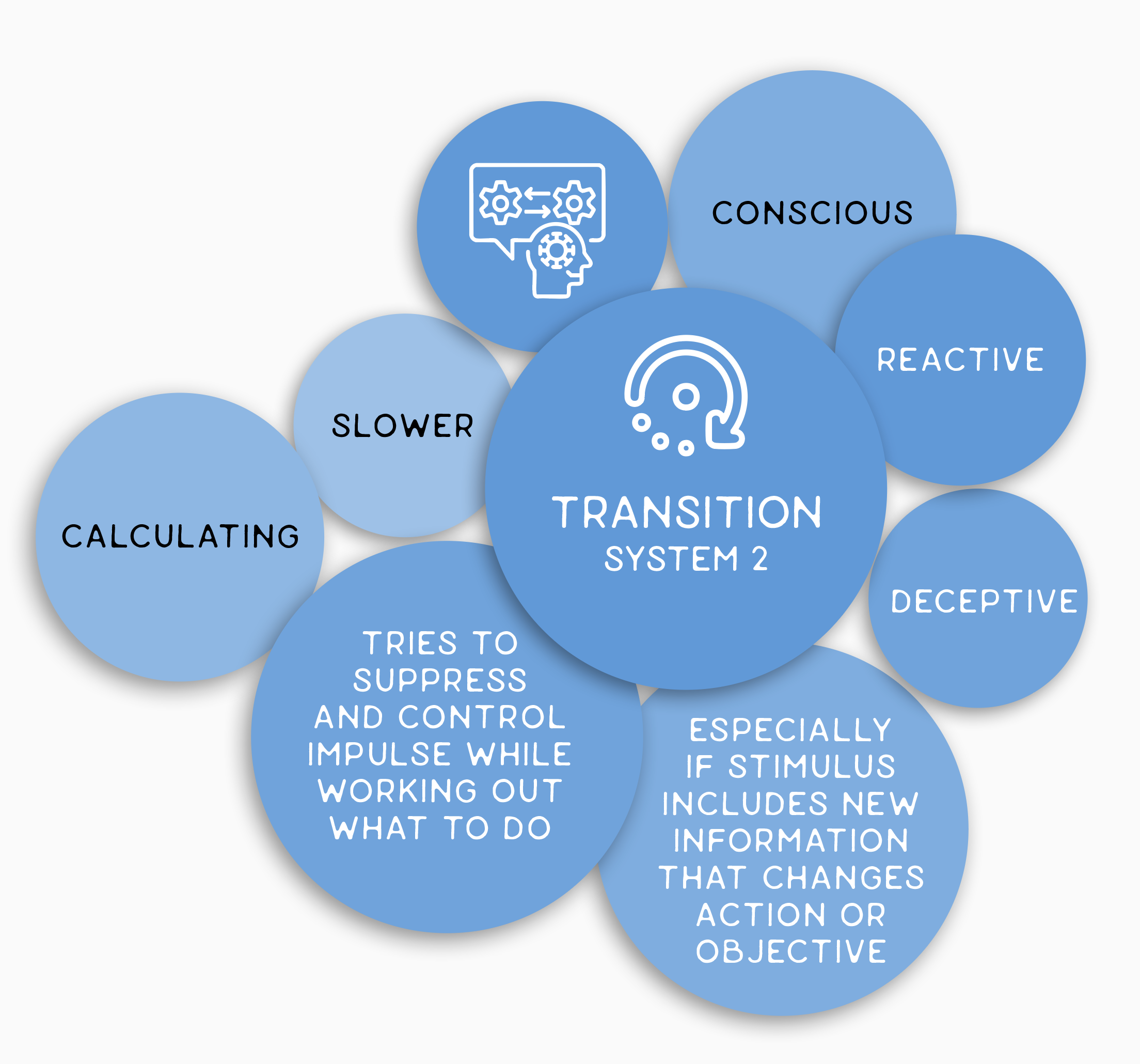
The Transition is a period of internal struggle between the impulsive response and the considered response. Actors have many ways of creating these moments; what matters is that we ascribe them to the character they are playing.
The first thing the conscious system does during the Transition is catch up with two things: what just happened (the stimulus), and what my impulsive system is doing in response – what it makes me feel, and what it makes me want to do.
Then the conscious system tries to put a lid on the impulsive system for as long as it can get away with, while it works out the best thing to do.
Sometimes the impulse is so strong that it can’t be controlled. The character is already acting purely on their instinct – in which case the conscious mind can only ride the tiger into battle.
More often the conscious mind manages to at least partially intervene, damp down the impulsive response and come up with a strategic response.
But it’s a big job. First, it has to get the impulse under control.
Then it needs to balance a whole lot of things:
- Does that mean what I think it means?
- Was it deliberate?
- Do they truly know what that means to me?
- Should I attack or conciliate?
- What did my instant preconscious reaction reveal?
- Should I cover it up?
- Can I cover it up?
- If not, can I disguise or relabel it?
- How do I get control of this situation?
- Can I still go on chasing what I was going for?
- Is it too late to pretend?
- Is it too late to change my mind?
- Am I taking too long to decide what to do? Have I already lost control of the situation?
- WHAT DO I DO?!
Despite all those steps, this moment can be very short, especially if the decision is to go with the impulse. But it can also be quite long. There’s an extraordinarily long transition in episode 6 of Rob Brydon’s series MARION AND GEOFF: The Second Hottest Day of the Year.
It can also be hidden from the audience for a while through an AMBIGUOUS NARRATIVE ELLIPSIS.
The great thing about transitions is that they are thoughts – and while we can know what someone is feeling, we can’t know what they are thinking. It’s hidden from us. We can only see that they’re thinking, and judge how loaded the process is. We read the effort and the anxiety, but not what’s driving the effort and anxiety.
And why is this great? Because it encourages us to project from our own experiences and feelings into that moment.
We can tell whether someone is genuinely going through an internal struggle, and how deep that struggle is. But we can’t know what they’re thinking – so instead we project into that moment of silent struggle what we would think in that situation. Or if we think we know them, what we think they would be thinking. Even then, we compare it to what we would think.
We do that from our own life experience. And our own experiences bring our emotions with them. Which we then donate to the character.
This is real identification with a character, and this is how it’s achieved. Identification is about coming to understand the character’s worldview and connecting with their choices at a visceral level, not just a logical one. It has nothing to do with whether they were kind to an old lady or patted a dog in the first scene.
When we connect with a character’s choices and actions, we put ourselves in their shoes. Often without even noticing. We’ve become complicit in their dilemma. Even more powerfully, we bring all our own experiences — and the emotional power of those experiences — to the story. We totally personalise their dilemma.
Strangely, this works even better when we get it wrong.
We learn more about the character when we’re wrong and have to reassess our understanding than when we’re right.
There’s nothing that reveals more to us about a character than when they do something that we rejected as an option. Or didn’t even consider as an option. That forces us to reassess our assumptions about their thoughts, worldview, and motivations, helping us understand them even more deeply.
These moments of realisation can happen to the character in the story, the audience watching the story, or both.
Just as we can realise that our assumptions were wrong – that the character sees the world and their choices in that world differently from how we do – the character can recognise that another character sees the world and their choices in the world differently from them, and that difference has consequences.
In the jargon of filmmaking, these moments of realisation are usually called a ‘reveal,’ unless the new information is the opposite of what we thought, and has significant consequences, in which case it becomes a ‘reversal.’
To this we can add Aristotle’s ‘anagnorisis,’ which is the character’s radical reevaluation of their perception of the situation, of others, or of themselves, arising from the reveal or reversal.
But no matter how long the transition or how difficult the choice, eventually the character must make a CHOICE and act upon it.

MOMENT OF CHOICE:
System 1 & 2 find accommodation (or one gets control),
chooses ACTION-IN-RESPONSE using ENERGY from original
NEED plus AUTONOMIC REACTION and NEW INFORMATION
This MOMENT OF CHOICE comes down to:
- STAY: Do I need to stay here and fight it out?
- STAY: Can I shift the grounds, and come at it a different way?
- LEAVE or CHANGE SUBJECT: Do I need to have this out with someone else somewhere else?
- LEAVE or CHANGE SUBJECT: Do I need to go and heal myself and arm myself before I come back and take this on again?
If it’s one of the first two, then the scene continues. If it’s the other two the scene ends, or shifts to being about something else.
The BEAT ends with the ACTION-IN-RESPONSE, which might be immediate, or might be delayed:

IMMEDIATE ACTION-IN-RESPONSE:
- New or modified OBJECTIVE can still be met within current situation
- Creates a new reverse STIMULUS on other character, which
- Must be able to be perceived by that character, and
- Therefore can be perceived by the audience
HERE & NOW

DELAYED ACTION-IN-RESPONSE:
- (Modified) OBJECTIVE cannot be satisfied in current situation
- Leads to new scene
ANOTHER TIME, ANOTHER PLACE
If the character can hit back here and now, they will. And if they do, their ‘hit back’ becomes a stimulus for another person in the scene –generally the one that just clobbered them at the beginning of the cycle.
The Cycle Starts Again
And so the cycle starts again, because this reaction creates an autonomic response in the other character, which forces them to begin a transition and so on.
Empathy, Projection & Narrative Insight
This whole process helps us engage with the characters through a mixture of Empathy, Projection, and Narrative Insight.
We feel empathy with the character by autonomically sharing their Autonomic Reaction. We feel what they feel. Then, during the Transition, we project into the blank space left by them as they try to work out what to do.
Next, we complete the picture by combining Empathy and Projection with Narrative Insight when we see what they choose to do in the Action-In-Response.
Finally, we compare their choice with what we would have done. We build a picture of their character by comparing them to us: ‘This is how they are just like me, and that is how they are different from me.’
In that process, each character in the story we are actively watching becomes a metaphoric representation of ourselves.
