Four Spheres of Conflict
A tool for giving your characters a range of obstacles to overcome, which gives your story more dramatic energy and your characters more depth.
To give your story depth and substance, you want your characters to face and overcome as many different obstacles as possible. The more kinds of obstacles your characters face, the more ways they are tested, and therefore the more powerful their journey, and the more insight we get into them.
As well, conflicts in one sphere trigger, escalate or reveal conflicts in another – especially in the second act, which is where most movies create meaning by having different conflicts that were planted in the first act multiply and build.
This tool helps you expand the range of conflicts by dividing potential sources of conflict into four arenas, because conflicts in each arena play out differently, and test different aspects of your character. You’re adding depth to your character by not having them plough the same furrow again and again.
Deliberately making your character confront a broad range of obstacles and conflicts gives your story substance, as long as the various conflicts eventually come together into a coherent story.
The Four Spheres
I divide the areas of conflict in a story into 4 different arenas.
Each arena gives your characters different obstacles to overcome, and restricts their agency in different ways.
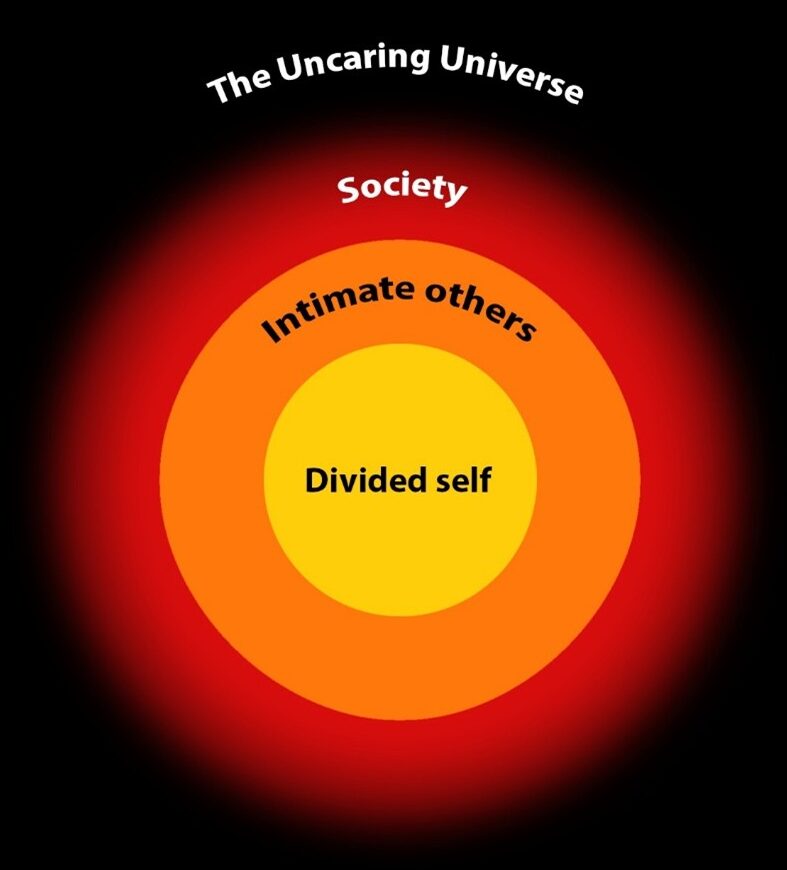
Starting from the centre, the four arenas are
- THE DIVIDED SELF: This is about Conflict or Contradiction within a single character.
- This is the struggle within a character, often between their persona (the constructed protective character they hide behind) and the person (the hidden or disguised true character, protecting themselves behind a mask or shield).
- Other kinds of internal contradiction come from being unwilling to confront unresolved contradictions in their intimate relationships, or in society.
- Or learned behaviour that sits at odds with their conscious values.
- At the beginning of most stories these internal conflicts are locked or compartmentalised. The character is trapped in a static situation that is partly external, and partly internal, and they have to overcome both to escape.
- Stories about the possibility of change are about a character’s journey from internal division and compartmentalisation to integration and coherence. Most English-language movies follow this pattern.
- INTIMATE OTHERS: This is about conflict or contradiction within one-on-one intimate relationships.
- Not all relationships with Intimate Others are sexual.
- Intimate relationships are simply relationships where each of you cares deeply about how the other feels, and how they feel about you.
- This limits your choice of action because of potential emotional costs. Your choices become more complex: you can’t just do what you want, because it will damage a relationship you care about.
- Most central characters have at least one intimate relationship in a story – usually more.
- They are the richest sources of complex conflict in a story.
- SOCIETY: Society is other people who are NOT Intimate Others. Although Society is also other people, it has a different kind of power than Intimate Others.
- Society has much more power over the individual than vice versa, principally through the law.
- Society’s laws can be both formal, with formal processes and specified outcomes, or implicit.
- Written laws operate through the justice system. Implicit unwritten laws primarily operate through shame, often imposed by Intimate Others.
- A character’s relationship with society is asymmetric. Actions taken by society have both tangible and emotional consequences for the character, but most characters have little or no tangible power over society.
- A character usually has to recruit allies before they can change society.
- THE UNCARING UNIVERSE: Everybody and everything else.
- Does not care who we are; how good (or bad) we are; or how important we are. Acts inexplicably and without concern.
- Some parts of Society effectively impact on the character as if they were part of The Uncaring Universe because they are so powerful, and so distant.
This analysis is a tool, not a rule. It helps find weaknesses in your story, and helps find solutions to those weaknesses.
You might ask, why not three spheres? Or ten? Because four is short enough to be usable, but long enough to be comprehensive.
Not all intimate relationships are the same. But the way they impact on the character’s ability to act freely is similar enough that the tool works. And it’s the impact that matters. This tool is about the different constraints on our agency:
- Divided Self → psychological constraints
- Intimate Others → emotional constraints
- Society → structural constraints
- Uncaring Universe → existential constraints
The ideas behind this tool permeate most of the essays on this site, particularly:
